Child to Parent Violence

Nine years ago I sat in a ob-gyn office looking at a pamphlet on domestic violence. I thought my partner is not the problem, but I am a domestic violence victim nonetheless.

During that pregnancy my adopted daughter kicked me in the stomach. During those years she subjected me to verbal abuse, kicked, punched, and hit me. We called doctors, the police, mental hospitals.  Her anger was explosive and violent, but nothing she has ever done is worse than the things her brother did in secrecy.

Back then I did research. There was no support or process for parents attempting to pursue legal avenues of protection against abusive children.

I persisted. I attempted to get her charged with assault. I asked the police to take pictures of the marks she left.

They told me she was too mentally ill to be incarcerated. They told me to tie her up.

Juvenile court dropped the charges.

When I look back to the long-ago beginnings of my relationship with these two very broken people I see that their violence defined the relationship throughout.  When young children with stories of neglect and abuse act out we may think there are solutions for caregivers in consistency, therapy, research, and time.

Maybe.

I never found those solutions.  I found that their problems were bigger than us all, that I was lucky to have survived at all.  Despite all our good intentions the advice I wish someone had given me twenty years ago—

Run fast, run far.
Swept out to sea

I can’t help but stare at the picture of this family swept out to sea. I know what it is like to attempt to parent children from “hard backgrounds.”

And yes, I have often tried to assuage my deep grief about the damage caused by my adopted children by telling myself that we have survived (so far).

None of this is fun to talk about, but I did talk–sometimes unsparingly, because I hoped that if people heard our story they could do something to prevent tragedies like ours.

More than the average mama, I can put myself in the shoes of these mamas, and I have two things to thing to say–

  • Why weren’t the children removed from the custody of the Harts in 2011 when there was a child abuse conviction?
  • And when a mother chooses to murder her children all the rosy adjectives no longer apply.

Just: a story of the lost and found https://www.amazon.com/dp/1468123459/ref=cm_sw_r_cp_api_JPNWAbDZT3TR5

Winter Storm

Over my shoulder I hear the PBS lady tell my sons about blizzards, how they are just snow storms unless the wind is strong and fast. Here in Texas we have driving rain, not driven snow, and it is the percussive light which wakes the dogs in the night. Poised for a fight. Hurricanes have the eyes of Quint’s soulless sharks as they roll across the landscape of childhood and wakefulness I will momentarily regret the home I left in fear. Regret what I did not leave there. Regret what I did, but not the winds. The winds around the eye, the deceptively calm eye, of every storm that changes the landscape

Of who we once were.

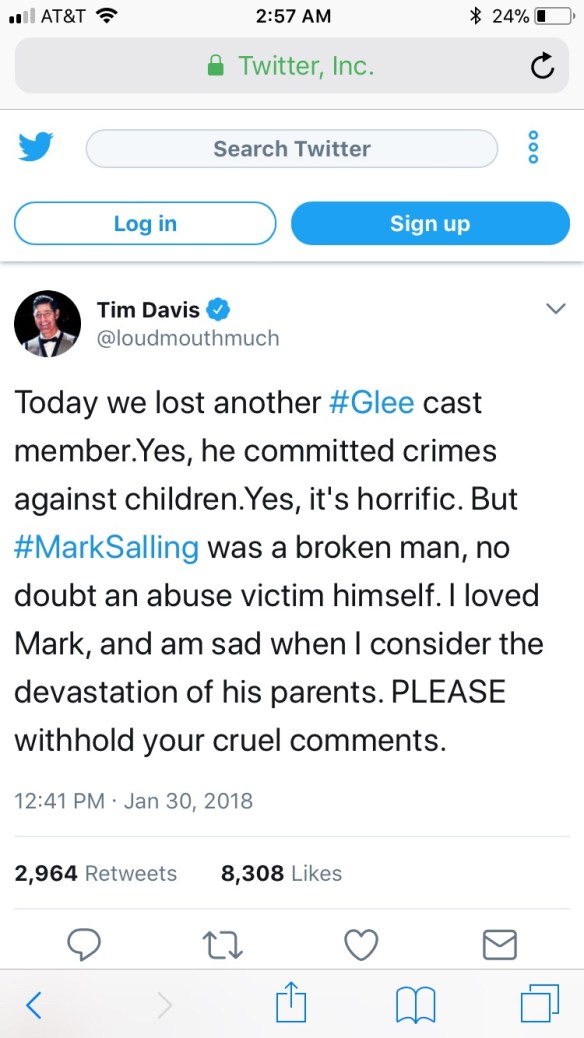
Tim Davis’ Inexcusable Excuse

No doubt an abuse victim himself?

Tim Davis either has inside information about someone abusing Salling as a child, in which case he should report that immediately to the authorities or he has just perpetuated the kind of ignorant, baseless assumption about abuse victims which makes it so difficult for the victims to heal.

Again, if Davis knows Salling was abused he better call the police.

And if he does not, he owes every last victim of sexual abuse (including Salling’s) a retraction and an apology.

Sexual abuse victims are not de facto abusers, and to insinuate so in order to excuse the inexcusable is, to borrow from Davis–a cruel comment.

Signs of Famine and Pain

Like most people I was appalled and distraught to read about what the Turpin siblings had to endure for nearly three decades. I will continue to grieve for them and pray for healing, justice, and recovery.

But I am angry as well. I am angry because despite (perhaps partially justified) calls to lay this abuse at the doorstep of homeschooling, there were so many people who interacted with the Turpin family, who saw at least some of the signs of abuse and yet no one ever reported anything.

At least two of the children went to public schools….

no one reported anything.

Neighbors saw odd behavior…

no one reported anything.

The children went to a doctor or two at some point in their lives…

no one reported anything.

Former neighbors found hard evidence of abuse and animal cruelty…

No one reported anything.

This is not the first time terrible crimes have been perpetrated by caregivers, ostensibly behind closed doors, but it is remarkable that the abuse intensified in severity and lasted so long because

No one reported anything.

Yet we hear them all now.

Note: if you suspect abuse or neglect you can make anonymous reports either by withholding your name or by relying that when you give your name to authorities your identity will not be shared in an investigation. Not one person who lived in proximity to the Turpins risked anything by making an anonymous report about signs of neglect or abuse.

If you suspect abuse, report

Thing One and Thing Two

There have always been problems with The Cat in the Hat-

  • Why the heck does the mom leave two young children home unattended?
  • Why doesn’t anyone heed the fish?
  • Why does the Cat come off as jovial instead of super creepy?
  • Which leads me to this:

One day he reads the story with his older sister. When he gets to the part about Thing One and Thing Two he has a few horrified questions. Who are they? Why do they live in a box? Do they ever get to see their mother? Why does the Cat/protagonist/ersatz guardian keep them in a box?!

His questions are so good and true and terrible and she cannot really answer them adequately. When she tries he says, in grief and anguish–but they are children, little children!

In the picture they took of you we strain to see your numbers, strain to see your faces. Look for something, someone to tell us it will all be ok.

As the last few lines of this children’s story

Indict us all.

Eldest Child

Something about Elvis impersonators, well-fed dogs, and raffles for them rattles around my head–keep asking myself what what can I give them? What can I do? When you were born I was still in college, George HW was president, both Princess Diana and Mother Theresa were still alive.

So many years of hunger.

I wish I could make it all better, like one of those chubby, diminutive fairy godmothers–change the immutable curse into a deep slumber, when you wake up

Wipe away all the tears from your eyes

Prepare a table just for you,

Things any decent mom would do…

Psalm 146:7 NIV

[7] He upholds the cause of the oppressed and gives food to the hungry. The Lord sets prisoners free,

She Storms

She storms in the kitchen finding bits of things to stop her mouth, wish it could stop the words spilling out. How could so many well-dressed people have their heads so firmly wedged up their

Freezing asses?

Fists should swing toward imaginary foes while the real ones all live among us, work at Walmart, never liked that effing little dog.

Any Boat in a Storm

It has been 30 years since I made the (not very complicated) decision not to vote for political candidates who support abortion.

Abortion on-demand–at-all-is and will be our generation’s genocide stain. The comparison to other genocidal impulses* is not that difficult to make–

  • Genocide systematically dehumanizes the victims
  • Genocide creates words and epithets to divide victims and devalue them from the rest of us
  • Genocide targets people who are legally exposed, minorities, female, from disenfranchised classes (often created through the repeated use of dehumanizing terms), the medically fragile, people whose basic human rights have been suspended or exempted
  • Genocide finds ways to stigmatize and blame the victims
  • Genocide labels victims as “unwanted”
  • Genocide institutionalizes, regularizes, industrializes, and monetizes mass murder
  • And many times genocide co-ops scientists and medical professionals by couching the process of mass killing as medically necessary or scientifically interesting
  • Genocide kills people.

Do you know the statistics for aborted people in your state, country or region? Do you know when it was legalized and who it targets?

You should.

We all should.

We will have to make an account for every one.

*for the purpose of cohesion I have not separated out gendercide, femicide, or the systemic killing of disabled people, all of which characterize abortion and have been components of genocide as well.